
 EN



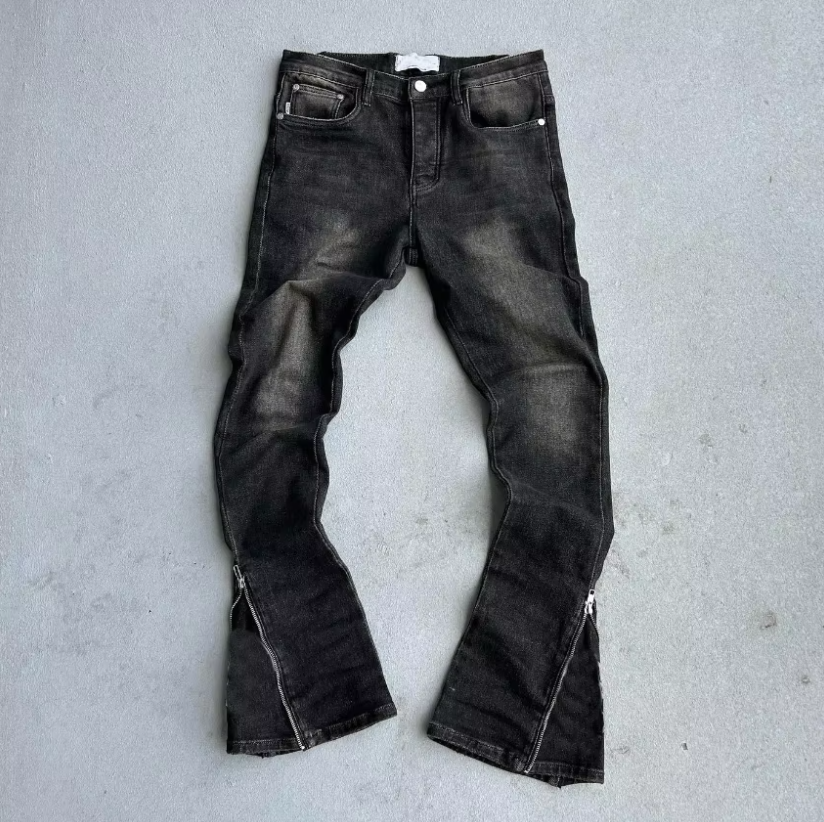
Why the Waistband Decides Whether a Bulk Jean Order Sells Through
A pair of jeans can have perfect legs, great wash, and clean stitching, yet still generate complaints. The waistband is where fit is judged first. It sits against the body, moves with sitting and bending, and controls how the whole garment hangs. For bulk orders, a waistband that varies from piece to piece creates returns, size confusion, and lost repeat business. Custom jeans live or die on this small zone.
The Anatomy of a Waistband That Stays Put
A good waistband is not just a strip of denim. It combines shell fabric, interfacing, curtain, and stitching. The curve matters. The height matters. The stretch recovery matters. On a low-rise pair, the waistband must follow the hip angle. On a high-rise pair, it needs to hold without digging. Interfacing adds structure but too much makes the band stiff. Too little lets it roll. Stitching affects how the band bends. These parts have to work together, and they have to do it across every size in the run.
What Goes Wrong When Waistband Fit Is Treated as an Afterthought
Common failures in bulk jean production include:
-
Waistband interfacing that is too stiff or too soft for the denim weight.
-
Grading that scales the waist measurement but ignores the waistband curve.
-
Inconsistent seam allowance at the center back join.
-
Stretch denim that recovers differently after washing.
-
Belt loops placed without checking alignment after the band is attached.
-
Size labels that follow vanity sizing instead of the actual pattern.
A recent case involved a men's slim jean program for a growing label. The sample waistband fit well on the fit model. In bulk, customers reported a gap at the back waist when seated and a loose feel after a few hours of wear. The pattern had been graded correctly on paper, but the waistband interfacing was switched to a lower-cost option. The new interfacing did not recover with the stretch denim. The center back seam also had extra bulk. The fix required a new interfacing spec and a revised waistband curve for three sizes. That kind of correction is possible, but it costs time and trust.
| Waistband factor | Well-controlled bulk order | Poorly controlled bulk order |
|---|---|---|
| Interfacing | Matched to denim weight and stretch | Chosen by price alone |
| Grading | Waist curve adjusted per size | Only waist measurement scaled |
| Center back join | Clean, flat, consistent | Bulky or uneven |
| Stretch recovery | Tested after wash | Assumed from sample |
| Belt loop alignment | Checked after band attachment | Placed by eye |
| Size consistency | Matches fit model and spec | Varies from piece to piece |
The Cost of Inconsistent Waistbands Across a Size Run
Waistband inconsistency is expensive in ways that do not show up on a quote sheet. A customer who orders two pairs in the same size and gets two different fits may return both. A retailer that sees size complaints may cut the next order. A brand that cannot trust its own size chart spends money on fit sessions, rework, and rush replacements. Over a season, those costs can exceed the savings from cheaper interfacing or faster grading.
Industry standards such as ASTM D5585 for adult male body measurements and ISO 8559-1 for size designation exist because fit is not a guess. They give a common language for body dimensions and garment specs. Using them does not guarantee a perfect waistband, but ignoring them makes consistency harder to defend.
How Sampling and Grading Protect Bulk Order Satisfaction
The waistband should be tested in sampling with the actual denim, interfacing, and thread. A sample that fits on one model is not enough. The fit should be checked seated, standing, and after movement. Grading should be reviewed at the waistband curve, not just the waist circumference. Pre-production samples should be washed and measured. If stretch denim is used, recovery should be checked after the expected care cycle.
A practical sequence:
-
Approve the denim and interfacing together.
-
Fit the sample on more than one body type.
-
Wash and measure the sample.
-
Review grading at the waistband and hip.
-
Lock the construction spec before bulk cutting.
-
Check the first bulk pieces against the approved washed sample.
What Buyers Should Ask Before Locking a Jean Program
Before committing to a bulk jeans order, buyers should ask how the factory controls waistband fit across sizes. Useful questions include:
-
How is interfacing selected and tested?
-
How is the waistband curve graded?
-
What wash and recovery checks are done on stretch denim?
-
How are center back joins inspected?
-
What records are kept for fit approvals?
A factory that can answer these questions with process, not promises, is easier to trust. A factory that treats the waistband as a simple strip will likely produce inconsistent fit at scale. The waistband is small, but it carries the customer's first impression of the entire jean.
For brands that need reliable men's jean production, Xinsheng in Humen offers in-house sampling, bulk manufacturing, and finishing capabilities that include washing and other garment techniques. A tested fabric library and flexible MOQs support both new labels and larger programs. The advantage is not one waistband pattern. It is the discipline of checking fit, wash behavior, and grading before the bulk order makes the result permanent.
Table of Contents
- Why the Waistband Decides Whether a Bulk Jean Order Sells Through
- The Anatomy of a Waistband That Stays Put
- What Goes Wrong When Waistband Fit Is Treated as an Afterthought
- The Cost of Inconsistent Waistbands Across a Size Run
- How Sampling and Grading Protect Bulk Order Satisfaction
- What Buyers Should Ask Before Locking a Jean Program